
Provisional credit can give your business faster access to money while a cash deposit or transaction is still being verified. That can help with cash flow, but the funds remain conditional until the process is complete, creating risks businesses need to consider.
For businesses handling significant amounts of cash, deposit timing affects working capital, accounting, and day-to-day operations. Understanding what provisional credit is, how it works, and when funds can be reversed can help you weigh its benefits and drawbacks against more predictable alternatives, such as our CashSimple® cash management solution.
- What Is Provisional Credit?
- How Provisional Credit Works
- Advantages and Disadvantages of Provisional Credit
- Alternatives to Provisional Credit
What Is Provisional Credit?
Provisional credit is temporary credit a financial institution provides before a transaction or deposit is fully verified and settled. For cash-heavy businesses, it can provide earlier access to working capital while the underlying funds move through collection, verification, and reconciliation.
This arrangement can make funds available sooner, but temporary credit is not the same as final settlement. That distinction matters when businesses plan spending, reconcile accounts, or manage cash across multiple locations. Businesses should account for the possibility that the final verified deposit will differ from the provisional amount.
What Is Provisional Credit Reversal?
A provisional credit reversal happens when a financial institution removes or adjusts credit that it previously added to an account. For cash deposits, a reversal or adjustment may occur when the final verified amount does not match the amount initially credited.
That difference can change the business’s available balance and complicate accounting or cash-flow planning. If a company has already treated provisional funds as settled cash, an adjustment can create an unexpected shortfall. Clear cash management practices can help finance teams track deposits and distinguish temporary funds from money that has completed verification and settlement.
How Provisional Credit Works
The exact provisional credit process varies by financial institution and cash-management provider. A typical cash deposit process may look like this:
- A business deposits cash into an eligible cash-handling device or system.
- The system transmits deposit information so the business can receive provisional credit.
- The physical cash remains in the device until a cash-in-transit provider collects it.
- The cash travels to a processing location, where it is counted and verified.
- The verified amount is reconciled against the original deposit information.
- The financial institution finalizes the deposit or adjusts the account if the amounts differ.
- A business has access to its deposited cash.
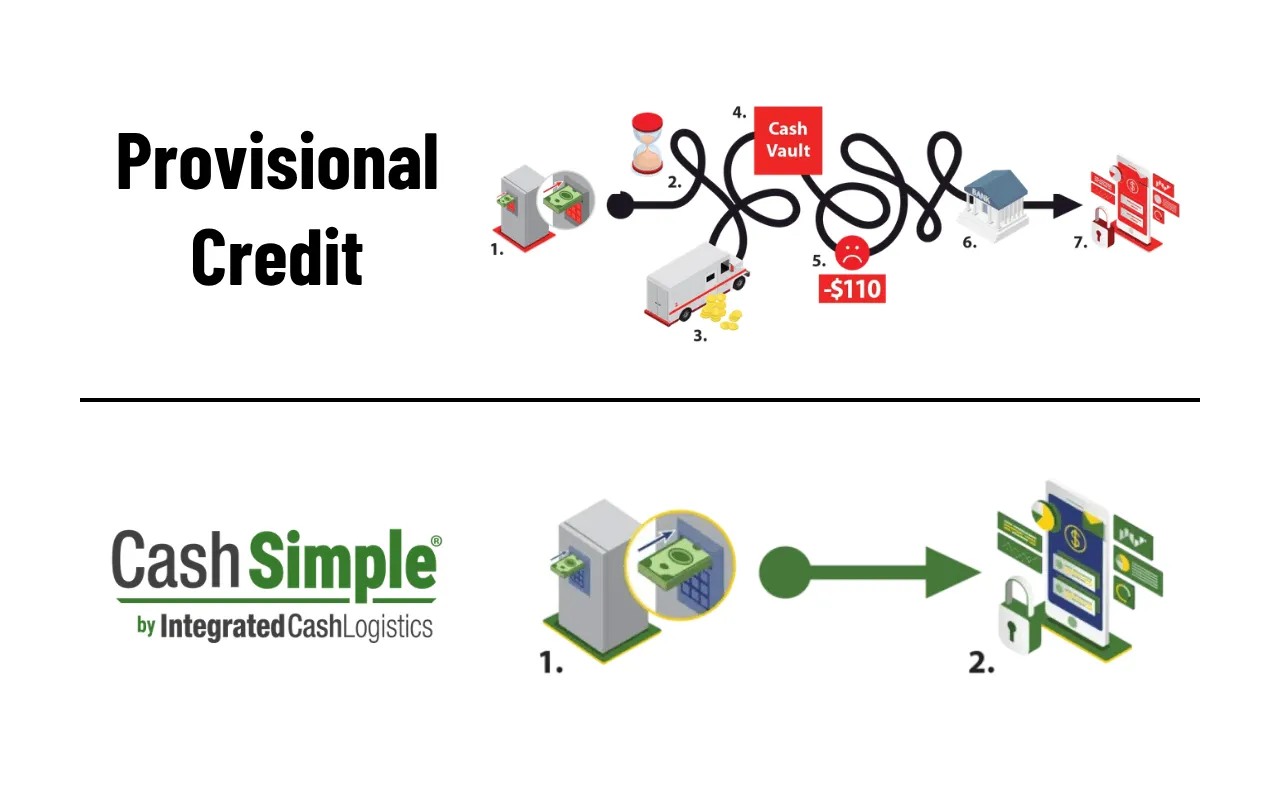
CashSimple® takes a different approach. Instead of extending credit against deposited cash, Integrated Cash Logistics (ICL) purchases the cash when it enters its cash capture technology and assumes responsibility for it, giving businesses faster access to their cash.
How Long Does Provisional Credit Last?
There is no universal timeline for how long provisional credit takes or remains in an account. Timing depends on the financial institution, cash-management provider, the armored carrier picking up the cash, verification process, and program terms. For multi-location businesses, that variability can make cash-flow planning harder.
With CashSimple®, deposits are made to the customer’s bank account the next business day, and an online portal lets you track deposit data.
Advantages and Disadvantages of Provisional Credit
The main advantage of provisional credit is earlier access to funds. Businesses do not necessarily have to wait for physical cash to complete collection and verification before seeing money credited to an account. That can support working capital and help businesses maintain a healthier cash float between deposits and final settlement.
However, that speed comes with conditions. Provisional funds can be adjusted or reversed, and the verification and reconciliation process can add uncertainty. Businesses comparing options should consider more than how quickly funds appear. Liability, accounting accuracy, cash-flow visibility, reconciliation work, and operational efficiency all affect whether provisional credit fits their risk tolerance and cash-management needs. Our cash liquidity calculator can also help businesses estimate how much cash may be tied up across their locations.
Alternatives to Provisional Credit
Businesses have several ways to access funds without relying on provisional credit. Traditional bank credit or business loans can provide access to borrowed funds, while trade credit can delay payments to suppliers. Invoice financing can provide funding based on unpaid customer invoices. Each option works differently and may involve borrowing costs, eligibility requirements, repayment obligations, or other terms.
For CashSimple®, once cash enters ICL’s cash capture technology, ICL purchases the cash, assumes responsibility for it, and deposits the actual funds into the business’s bank account of choice rather than providing temporary credit against the deposit. This model gives businesses an alternative that addresses the cash itself rather than relying on borrowed or conditional funds.

Access Your Cash Sooner With CashSimple®
Provisional credit can make funds available sooner than waiting for an armored carrier to pick up the cash and deposit it, but that access remains tied to verification and final settlement. Businesses weighing this option should consider the possibility of adjustments or a provisional credit reversal alongside the potential cash-flow benefit.
CashSimple® removes that provisional credit step by purchasing cash once it enters ICL’s cash capture technology. ICL then deposits the funds into the customer’s bank account of choice, giving the business access to its cash while transferring responsibility for the physical cash to ICL.
For businesses looking to spend less time managing cash and more time running their locations, schedule a demo to learn how the CashSimple® solution can simplify the path from cash receipt to bank account.

